|
Company Operational Manual COM 2.14 Management of Change |
Doc No.: COM 2.14
Revision: 1 Date: 15 Oct 2024 Issued by: DPA Approved by: MD |
1. APPLICATION
This document applies to all employees in the company.
2. PURPOSE
To specify procedures for management of organizational or design changes to ensure that modifications and changes are adequately assessed with regard to practical implementation, impact on the organization and the Company Management System, and to avoid unwanted hazards and to ensure that safety and environmental standards are not compromised.
3. PRINCIPLES FOR MANAGEMENT OF CHANGE
3.1 Standard for Management of Change (MOC)
The company has adopted principles contained within the ABS Guidance Notes on Management of Change for the Marine and Offshore Industries.
All processes which require change, not specified in Section 4 Standardised Workflows, shall follow the general management of change process in Section 5. Standardised workflows will differ from the generic MOC process listed below to better suit the specific requirements of that process.
Note:
- A11- Management of Change may be used for generic changes or for processes not having a dedicated change management form.
3.2 Requirement to Carry Out a MOC
When an item, process or person meets the existing specified criteria for the item it is replacing, it is typically not considered a change, but a “replacement-in-kind”. This will typically not require a MOC form.
Note:
- COM 2.13 may be used as a checklist to assist in determining if a change is needed.
3.3 Documentation and Filing
A MOC form is required for each change. The form is essential to allow the necessary information to be gathered and recorded efficiently and effectively. All required and identified documentation supporting the change must be filed against the MOC form.
Note:
- All MOCs must have a MOC form and all MOCs must be filed either on an established log on against the office or shipboard filing system.
3.4 Risk Assessment
FOM 10.16 Risk Assessment shall be used as the basis for all MOC evaluations.
4. STANDARDISED WORKFLOWS
The following standard work processes have been identified. For clarity, certain processes have roles defined.
| Process | Change Responsibilities | Forms | MOC Log |
|---|---|---|---|
| Taking new tonnage under management | Fleet Services - Coordinator Vessel Manager, Fleet Group Manager | A16 | Intranet / HSSEQ |
| Organizational changes or New hire to the company (Shore staff) | Chief HR Officer | HR05 | HR Records |
| New hire to the company (Ship staff) | Chief HR Officer - Lead Head of Crewing Operations | CRW02,09-14 | Crewing Records |
| Installation & modification of onboard equipment | Ship board senior management/ Vessel Manager – Change Manager | A11 | Intranet / Technical |
| Fleet Group Manager/Technical Manager – Changer Approver | |||
| Installation & modification of onboard software | Master – Change Manager, Vessel Manager/Group IT - Approver | A27A | IT Log |
| SMS Changes (Refer COM 2.12) | Head of Dept., QA – Shore MOC Coordinator Procedure Reviewer – Reviewer – Change Manager, Procedure Approver - Approver | Electronic MoC / A27 | SharePoint |
| Security system changes | Security department | HSSEQ19A | Security records |
| PMS Changes | Technical department | A27 | PMS records |
| Emerging requirements | Head of Dept. – Change Manager, ET Member - Approver | A27 | Intranet / HSSEQ |
| Changes in trading areas | COO | A11 | N Drive / Onboard filing |
| Temporary isolation and reactivation of shipboard alarms for maintenance purposes | Ship board senior management | A11 | N Drive / Onboard filing |
5. MOC PROCESS
5.1 General
In general, all MOCs typically require the following steps:
- 1. Initial Review
- 2. Senior Review
- 3. Detailed Risk Assessment
- 4. Approval
- 5. Implementation
- 6.Verification and Closeout
An overview of the MOC process is depicted in the flowchart below (Figure 1).
5.2 Initial Review
- Involves the following 3 steps:
- Justification and coverage
- Preliminary Impact Assessment
- Implementation Plan
- The change requestor and change owner shall jointly assess the potential consequences of the change.
- The risk assessment may be scaled either up or down depending on the complexity of the change.
- The implementation plan shall describe how the change will be executed and must include specific actions, timelines, and responsibilities.
- Implementation plan shall have actions that serve to make identified risks tolerable.
5.3 Senior Review
- The approver shall review the basis of the change, determine if the preliminary impact assessment has not overlooked significant concerns, and verify that the implementation plan has identified all necessary steps in executing and managing the change.
- If the approver is not satisfied with the initial review, the following may be done:
- Initial review is repeated.
- Change is rejected.
- A detailed risk assessment is requested to be conducted, and the resulting implementation plan to be redone.
- The MOC form shall be updated and the resulting action from the Senior Review shall be stated on the form and filed.
5.4 Detailed Risk Assessment
- Shall be made if the approver determines severity of anticipated impacts or complexity is high.
- Normally involves subject matter experts.
- Risk assessment team is large and multi-disciplinary.
- Deliverables would typically include:
- Nature of risks to be controlled
- List of requirements or controls that need to be implemented before effecting the change.
- Once failure scenarios are identified, the consequences can be assessed on the basis of negative impacts to health and safety, the environment, crew and ship or offshore facility security, and financial/commercial values.
- HSSEQ-18 Risk assessment may be used.
5.5 Approval
- The change may only proceed once the preliminary impact assessment or detailed risk assessment is approved.
- The approver shall verify the results of the initial impact analysis.
- A change whose potential impacts have been poorly analysed may result in insufficient implementation planning. This will increase risk exposure and the likelihood of significant and detrimental impacts.
- The approver shall be competent in the field or domain where the change is occurring.
Coution:
5.6 Implementation
- Involves:
- Execution of change and implementation plan.
- Updating documentation to reflect the change.
- Communicating the change.
- Training personnel on the change.
- Documentation may include:
- Drawings, plans, schematics, inspection and test plans, commissioning documents, procedures, checklists, permits, emergency response plans, training manuals, software code, signage, regulatory approvals, etc.
- Modifications to the change documentation such as updates to the risk assessment or updating of actions must be communicated to ensure transparency of the MOC process.
- Change should be communicated to all those who may be affected by the change.
- Communication should occur before the change takes place.
- For the case of emergency changes, where by nature the change cannot be communicated beforehand, the notification should take place immediately after the execution of the change to advise oncoming shift personnel.
- The manner and breadth of communication/training should be reflective of the complexity of change (examples are e-mail, announcements in meetings, tool-box talks, safety meetings, full awareness campaigns, formal training, etc.).
- Circulars may be used to communicate with both the ship and shore personnel. QA department may be consulted regarding communication via this method.
- Relying on passive notifications such as entries in logbooks or documentation in procedures should not be the sole way of communicating to personnel since they could easily be overlooked by personnel that need to be aware of the change.
- Communication will also need to be made to other departments and external stakeholders such as owners, charterers, flag state, class, regulatory bodies, etc.
- Training is required when there are significant changes to existing conditions.
- Awareness training or detailed training of the new practice must be provided.
- Before executing the change, the change owner should confirm that all risk control measures from the risk assessments are on target with the implementation plan, and that the affected personnel are trained and informed of the change.
Note:
Note:
5.7 Verification and Closeout
- Changes shall be reviewed for effectiveness after a maximum of 90 days after coming into effect.
- Reviews of effectiveness shall occur at each quarterly management review.
- Changes will be evaluated to determine if they are meeting their intended functions, if follow-up actions are completed or on target, and if extension of the review period is required.
- Changes shall only be closed after they have been deemed to be effective.
- Lessons learnt, where applicable, shall be documented and shared.
- Temporary changes do not exceed the initial authorization for scope or time without review and re-approval by the approver.
- Any changes not carried out within the proposed timescale shall be reviewed, revalidated, and approved.
- All documentation shall be signed.
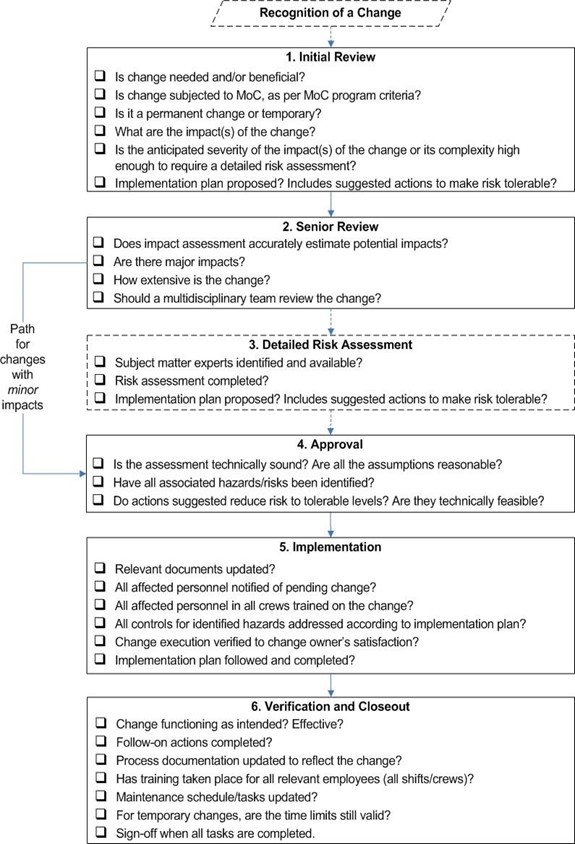
- Figure 2 is a process summary of each MOC process step. It may be used as a checklist for the monitoring of a change.
Note:
6. MOC ROLES & RESPONSIBILITIES
6.1 Change Requestor (Initiator)
- Anyone in the Company.
- Works with the change manager in developing the MOC supporting documentation.
- If at an officer level or supervisory/managerial level, may be the change owner as well.
- Helps the change owner prepare the initial review.
6.2 Change Owner
- Person at an officer level or supervisory/managerial level with responsibility in the area where the change is proposed.
- Works with the Initiator in preparing the initial review.
- Ultimate responsibility for the change, in addition to ensuring that implementation, monitoring, and training are carried out.
- Primary responsibility is to confirm that the change was implemented according to the implementation plan and subsequently verify that it is functioning as intended.
6.3 Approver
- Senior level (e.g., Master, Chief Officer, Chief Engineer, Head of Dept., or Executive Team member).
- Appraises the Initial Review to confirm the need for change and validate the preliminary impact assessment and implementation plan.
- Determines if a detailed risk assessment is needed.
- Determines who the relevant experts are to carry out the detailed risk assessment.
- Signs off on the risk assessment outputs, including the implementation plan, and designates the personnel to carry out the implementation plan.
- Cannot be the Change Owner.
Note:
- The role of MOC Coordinator is not required as standardised workflows have been defined and shall be handled as via of normal line management and coordination processes.
7. SPECIAL CIRCUMSTANCES
7.1 Emergency Change
- An emergency change is a change that must be performed in an emergency where action is required quickly, and the persons required to provide approvals may not be available to meet the requirements of the written MOC process.
- In these “emergency” situations, the change should be reviewed to the best of the staff’s abilities. This typically involves “verbal” MOC processes.
- This emergency MOC process should involve a risk assessment using any or all available resources and time to evaluate the risks involved with the change.
- Situations such as the following may require an emergency MOC:
- Correction of a deficiency that would cause an immediate threat to the safety of the ship or offshore facility or personnel/environment.
- Imminent environmental release.
- Impending external threats that could result in a loss of cargo, such as natural disasters, security threats, or extreme temperatures.
- At the first opportunity after the emergency has been controlled, the change must be fully evaluated and documented using the MOC procedure. The reviews will dictate if the change should be:
- Reversed to continue operations as in the pre-emergency status or
- Converted to a temporary or permanent change.
7.2 Temporary Change Description
- A change that is temporary in nature.
- It involves reverting to an original status within a specified timeframe (max 90 days).
- A review and re-approval should be carried out if a temporary change exceeds the initial authorization for scope or time.
- Temporary changes may include:
- Disabling a safety or critical system or equipment for non-routine or unplanned maintenance or due to a breakdown.
- Temporary alterations to alarm settings.
- Temporary operation with specific safeguards bypassed or inoperative.
- Temporary de-activation of security features for carrying out maintenance or operation.
- Installing temporary piping, clamps, connections, utility connections, wiring, or hoses (cold work on fire line).
- Short term use of a new port.
- Documentation and Recording:
- For a temporary change, a risk assessment should be carried out, and relevant control measures identified and enforced.
- The risk assessment should be reviewed in office and confirmed to comprehensively cover all aspects and impacts.
- The risk assessment may be recorded on the form HSSEQ-18 ‘‘Risk Assessment’ or A11 ‘Management of Change’, part ‘1-B’, as appropriate.
- Temporary changes should be appropriately recorded under the sections ‘Equipment Failure’, ‘Flag Dispensations’ and ‘Condition of Class’ on Intranet, as applicable.
- Defect and unplanned maintenance, if any (in relation to a temporary change), should be managed and recorded in accordance with the procedure FOM 7.1 ‘Maintenance’, section 4.5 ‘Defect reporting and unplanned maintenance’.
- Example:
- If a fire alarm sensor in the engine room malfunctions and needs to be deactivated until the required spare is available, a temporary change management shall be carried out. For this change, the engine drawings, design documentation will not require changing, but appropriate temporary procedures may need to be implemented to manage the change.
- Risk assessment will be required to identify all relevant hazards and associated risks. The risk assessment should draw the necessary control measures for minimizing the risk and reducing it to acceptable levels, and these should be enforced by the ship staff. For example, risk mitigation may require that the engine room remains manned if the vessel was normally operating under UMS mode.
7.3 Responsibilities
7.3.1 Change Requester
- The person who initiates a request for change.
- If ship staff proposes a change, the same must be initiated by shore staff.
7.3.2 Change Manager
- Has the overall management responsibility for the change management process.
- Responsible to ensure that all aspects of the management of change process are undertaken, completed, and signed out.
7.3.3 Procedure Reviewer
- Typically, the Head of the department which authors the document or procedure.
- Responsible to verify the accuracy and quality of content.
- Ensures risk evaluation and impact of the change is identified and managed.
7.3.4 Procedure Approver
- Member of the executive leadership team (ELT).
- Responsible to ensure that all information within the document is aligned with the Company’s Vision, Mission, Core Values, Code of Conduct, policies, and overall strategy.
Note:
- Please refer to SMS index for the list of procedure reviewer and approver of the documents.
7.4 Initiation
- Requirement for change is identified by Change Requester.
- Suggestion for revisions, amendments, and improvement will be done by submitting a change request via the electronic CSM Management of Change portal on the SharePoint.
- Complete the electronic A27 Change Management System Revision Request part A and B1. Once submitted, the procedure reviewer will receive an email notification to fill up part B2.
- It is strongly advised to discuss and agree upon the change with the procedure reviewer prior to filling out A27 to avoid unnecessary administrative work should the change request be rejected.
- Minor changes/revisions do not require submitting of A27. These are changes relating to editorial changes i.e. grammatical, spelling, formatting, etc. Minor changes are changes that do not affect the intent of the text.
- Part A shall describe details of the change, reason, affected CMS documents, and other options explored.
- Change Requester shall carry out a preliminary Risk Evaluation as part of part B1.
- Part B1 shall detail change category, urgency, legal or regulatory factors, external approval factors, training requirements, and other implications.
- The procedure reviewer shall review parts A and B1 and assess the validity of the change and how it impacts the system and other aspects of the Company.
- The procedure reviewer shall complete Part B2.
- It is advised that the procedure reviewer and change requestor jointly assess the impact of this change when completing Part B2. The risk evaluation shall include a formal risk assessment. HSSEQ18 may be used.
- Each change management system revision request will be given a unique identification number in the format “CSM201-Year-001” which is recorded in the Change Control Log on the SharePoint.
Coution:
Note:
Note:
7.5 Approval
7.5.1 Process
- The procedure reviewer indicates (yes or no) if the change request is valid and shall seek formal approval from the procedure approver.
- The procedure approver shall review Parts A, B1, and B2 to assess if the change request is to be approved.
- The procedure approver shall indicate (approved/rejected) if the change request is approved.
- Change requestor will then receive an email to notify the status of the change request.
- Head of Department, HSSEQ shall determine if the approved change request complies with the TMS system philosophy prior to commencement of drafting or revising of documents or prior to publishing into the system.
- If not, the Head of Department, HSSEQ shall work with the Requestor, Reviewer, and Procedure to determine how the change can be effected.
- The person / personnel directly involved or responsible in the area of operation impacted by the change cannot be involved in the approval process of the change. Another person outside of the department or line of responsibility may be appointed to review the change prior to approval.
Note:
7.5.2 Rejected Revisions
- When a rejected Change Management System revision request is rejected, it cannot be reopened.
- If the Change Requester wishes to resubmit the Change Management System revision request, they must open a new Change Management System revision request, include reference to the original rejected Change Management System revision request, and include additional information as necessary.
Note:
- The decision to accept or reject shall always be communicated to all parties by the person making the decision.
7.5.3 Drafting and Revising
- Approved changes shall initiate the drafting and revising of identified documents.
- QA department shall:
- Make changes to existing documents.
- Distribute templates to the authoring department for new documents.
- Send completed drafts to procedure reviewers for verification.
- Procedure reviewer shall send completed final drafts to procedure approvers for final approval.
- Final approved change request shall be uploaded as an attachment in electronic form in SharePoint or sent to HSSEQ.
Note:
- Confirmation of approval indicates that this document is ready to be published and the revision will be changed from letters to numbers denoting that this document is ready to be used.
7.6 Implementation and Review
- For SMS revision changes, the procedure reviewer and procedure approver shall monitor changes.
- Change Manager to complete Part C within 90 days on the effectiveness of the implementation and determine if further modification is required.
- If required, the change requestor will have to submit a new electronic CSM in SharePoint and reference the original Change Management System revision request. Feedback shall be given to the Change Manager for inclusion in the quarterly management review.
7.7 Information and Distribution
- QA department will issue an HSSEQ circular for all major and significant changes to be implemented to relevant parties affected by the change.
8. APPENDICES
- COM 2.11 New ship in management
- COM 2.12 New revision of Company policy or procedure
- COM 2.13 MOC Decision Checklist for Onboard Modifications